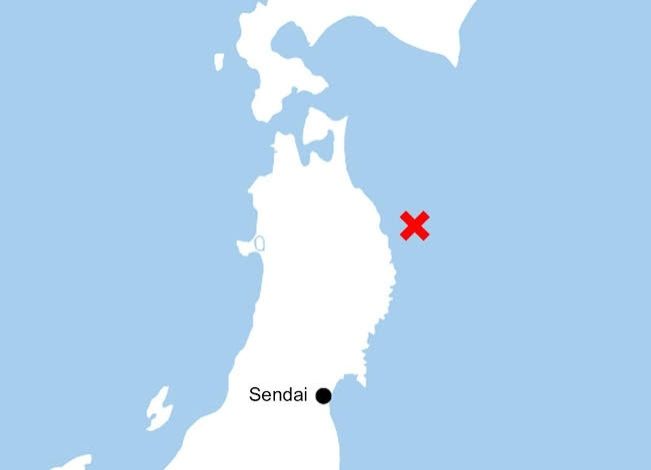
A powerful 7.2-magnitude earthquake jolted northern Japan on Thursday, June 25, rattling kitchens and workplaces across the region but leaving the country largely unscathed. The tremor, centred in the sea off Iwate prefecture at a depth of 44 kilometres, rippled across hundreds of kilometres to reach Tokyo by morning. The Japan Meteorological Agency initially measured the quake at 6.9 magnitude before revising the figure upward, underscoring the precision required in seismic assessment even in a nation with sophisticated monitoring systems.
Eyewitness accounts painted a picture of sudden disruption rather than disaster. Mutsumi Shimohata, a 61-year-old food processing worker in Hashikami, Aomori prefecture, described the characteristic warning signs that Japan's early alert systems now provide. An alarm sounded on her smartphone just moments after the shaking began, a technological buffer that has become routine in Japanese daily life. While her own home escaped with only a fallen picture frame, her workplace experienced more pronounced effects—the automatic doors malfunctioned and sections of the ceiling gave way, prompting her company to send employees home as a precaution.
The wider physical toll remained contained. Television footage captured the mundane chaos of the moment: kitchen cupboards disgorged their contents in grocery stores, shelves in shops spilled merchandise onto floors, and unsecured items tumbled from heights. In Aomori prefecture, the tremor registered at the upper end of Japan's seven-level Shindo intensity scale, a measurement that indicates potentially dangerous conditions. At this intensity, standing without support becomes difficult and furniture topples easily, yet the extent of actual damage stayed remarkably limited. Emergency services received only a handful of calls, including reports of a stuck lift and jammed doors, while one incident involved an overturned tanker truck—serious enough to warrant response but not indicative of widespread catastrophe.
Infrastructure proved resilient. The shinkansen bullet train network suspended some services as a precautionary measure, a routine response that prioritises passenger safety in a country where rail networks carry millions daily. A primary school in Hashikami closed temporarily, reflecting the institutional caution that pervades Japanese emergency protocols. Yet essential services continued functioning; NHK footage showed normal traffic flow in Hachinohe city with traffic lights operating as normal. Government spokesman Minoru Kihara stated that no human casualties had been reported, though authorities maintained a watching brief on developing situations.
Nuclear facilities in the affected region experienced no abnormalities, according to the Nuclear Regulation Authority's assessment. This reassurance carries particular weight in Japan, a nation still processing the legacy of the 2011 Fukushima disaster. That catastrophic combination of a 9.0-magnitude undersea earthquake and the tsunami it generated killed or left missing approximately 18,500 people and triggered the worst nuclear accident in decades. The memory shapes every official response to seismic activity, making nuclear safety verification an immediate priority in any tremor assessment.
Prime Minister Sanae Takaichi swiftly ordered government ministries and agencies to coordinate with local authorities, signalling the national apparatus mobilising even in the absence of confirmed major damage. Her public statement on the social media platform X carried a warning characteristic of Japanese earthquake culture: residents should remain vigilant for subsequent tremors of similar intensity. This counsel reflects geological reality and hard-won experience. Japan sits atop four major tectonic plates along the Pacific Ring of Fire's western flank, positioning the archipelago at the intersection of relentless geological forces.
The seismic frequency that Japan experiences is almost incomprehensible to residents of more geologically stable regions. The nation records hundreds of earthquakes annually and accounts for roughly 18 per cent of the world's seismic energy release—a staggering concentration of geological activity. Most tremors barely register in public consciousness, yet the constant low-level shaking has fundamentally shaped Japanese building codes, urban planning philosophy, and civic consciousness. The vast majority cause no damage whatsoever, though each incident reminds authorities of vulnerability.
Just two months prior, in April 2024, a 7.7-magnitude earthquake struck northern Japan, injuring at least ten people and shaking office towers in Tokyo with sufficient force to alarm residents hundreds of kilometres away. That event prompted authorities to issue an extraordinary advisory warning of elevated earthquake risk, specifically flagging the possibility of future tremors measuring 8.0 magnitude or stronger. The advisory remained in effect for a week before being lifted, reflecting the balance Japanese authorities maintain between legitimate public caution and avoiding unnecessary alarm fatigue.
This June earthquake, by contrast, followed a relatively quiet interlude—though in seismic terms, quiet remains relative. The pattern demonstrates Japan's paradoxical position: the nation experiences seismic activity that would constitute major news events in most countries, yet when no significant damage materialises, such occurrences barely register internationally. For Malaysian and Southeast Asian readers, Japan's earthquake experience offers a sobering contrast. While the region faces numerous natural hazards including typhoons and floods, major earthquakes remain comparatively rare. Japan's sophisticated early warning systems, stringent building codes, and public preparedness represent the accumulated knowledge of a population that cannot escape geological reality but has learned to live alongside it.