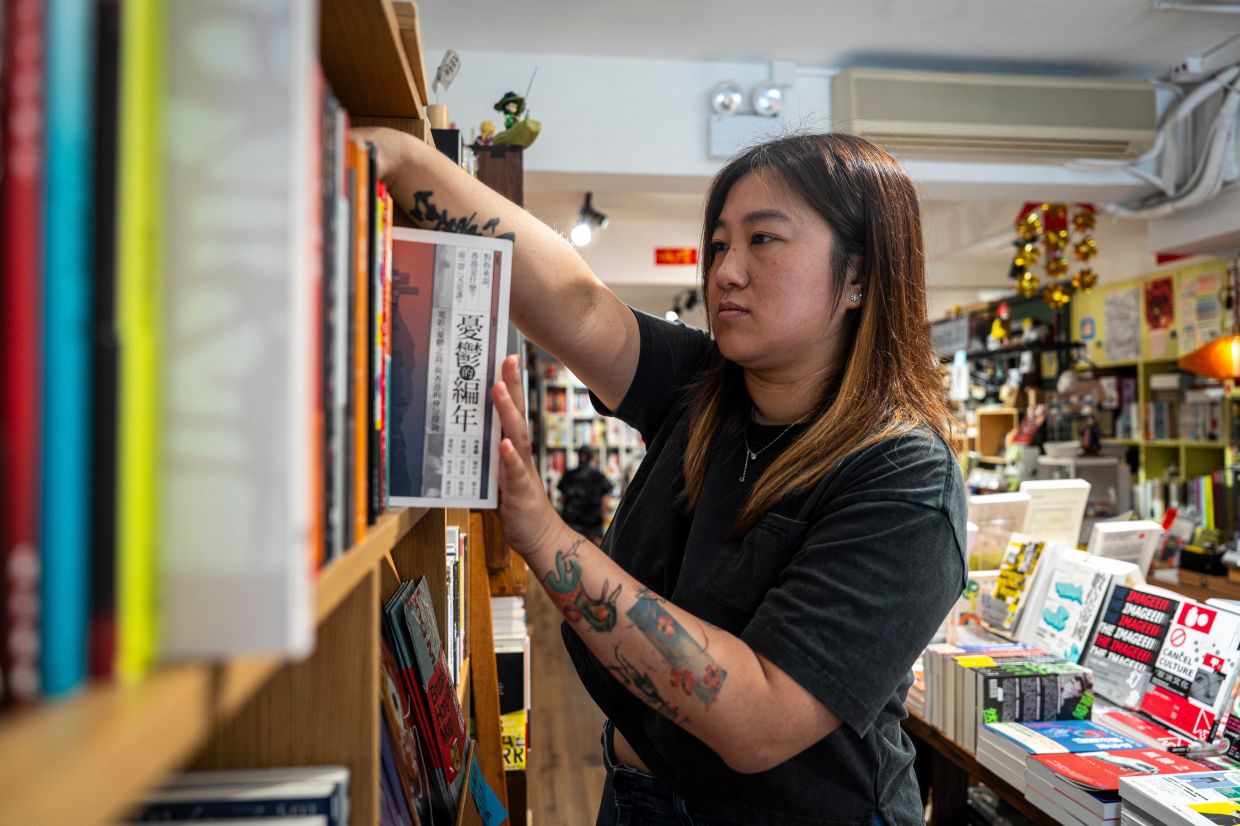
Hong Kong police have taken two individuals into custody on suspicion of distributing seditious publications and accepting funds from overseas political entities, deploying powers granted under the national security framework introduced in 2024. While the government declined to name those detained, local news organisations including Ming Pao cited sources indicating that one suspect is Leticia Wong, owner of Hunter Bookstore and a former pro-democracy district councillor who has maintained her vocal opposition to the authorities despite the imprisonment of numerous activists following the tumultuous 2019 demonstrations.
Wong's potential arrest would represent a striking symbolic development in Hong Kong's trajectory toward tighter political control. As someone who has consistently refused to moderate her positions even as the space for dissent has contracted sharply, she has become emblematic of residual resistance within the city's civil society. Her bookstore, situated in the Sham Shui Po district, has emerged as one of the few remaining venues where unorthodox publications remain accessible to the public, transforming it into a subtle focal point for those seeking alternative viewpoints in an increasingly homogenised information environment.
The timing of these arrests carries particular significance, arriving merely a week before Hong Kong commemorates the 29th anniversary of its reversion to Chinese sovereignty. This temporal proximity underscores international concerns about the systematic dismantling of the autonomy and freedoms that were ostensibly guaranteed under the "One Country, Two Systems" framework established during the 1997 transition. For regional observers and international observers alike, the pattern of enforcement suggests that Beijing's original commitment to preserving Hong Kong's distinctive governance model has progressively eroded, with each new legal instrument providing authorities with expanded latitude to pursue political objectives.
According to official statements released Thursday, the two individuals allegedly curated and disseminated materials designed to incite hostility toward the government apparatus, judiciary, and law enforcement establishment. Investigators further allege they received financial transfers originating from foreign political organisations, suggesting an international dimension to their operations. Significantly, the authorities have withheld specification of which particular publications or organisations fall under scrutiny, a vagueness that amplifies concerns about the subjective application of these broadly defined statutes.
Wong's bookstore has previously attracted official scrutiny linked to its commitment to stocking publications related to prominent pro-democracy figures. In 2024, a pro-establishment newspaper characterised an independent book fair hosted at her location as embodying "soft resistance," and specifically criticised plans to sell a biography of imprisoned pro-democracy businessman Jimmy Lai. This labelling demonstrates how authorities employ cultural and ideological frameworks to construct narratives justifying enforcement actions against what might otherwise appear to be ordinary commercial activity.
The regulatory pressure targeting Wong's establishment extends well beyond this recent arrest. In an interview conducted last year, Wong disclosed that government agencies had undertaken enforcement actions against her shop on 92 separate occasions between July 2022 and June 2025, encompassing inspections, conspicuous police patrols positioned outside the storefront, and cautionary letters detailing alleged violations. Beyond direct governmental action, she described how anonymous correspondence sent to an organisation planning to hold an event at her premises prompted the group to withdraw their booking, illustrating how intimidation operates through both direct and indirect mechanisms.
This enforcement pattern reflects a broader clampdown on bookselling establishments perceived as ideologically unreliable. In March of this year, police apprehended the proprietor and staff of another bookstore on comparable charges, with investigations focusing on the distribution of materials including the Lai biography. Although those individuals were subsequently released on bail, the operation demonstrated the systematic nature of these investigations across the sector. The repeated targeting of booksellers suggests authorities regard control of published materials as fundamental to managing political discourse within the territory.
The 2024 national security legislation under which these arrests proceed represents a substantial expansion of governmental authority compared to earlier legal frameworks. Previous iterations of security law operated within certain defined parameters; the current statute provides remarkably expansive language that permits authorities to interpret sedition and related offences with considerable discretion. This architectural feature of the law transforms it into an instrument of significant concern for those engaged in activities involving the circulation of information or ideas that could plausibly be construed as challenging official narratives.
For the broader Southeast Asian region, developments in Hong Kong carry cautionary implications. Malaysia and other nations in the region have observed how sophisticated authoritarian governance can employ ostensibly neutral legal mechanisms—security legislation, sedition laws, foreign interference statutes—to systematically constrain political opposition and control public discourse. The Hong Kong precedent demonstrates that such frameworks, once implemented, tend toward progressively more expansive application rather than restraint, particularly when political leadership prioritises stability over pluralism.
The Hong Kong government maintains that the security measures are indispensable for preserving stability and insists that freedom of expression remains robustly protected. However, the mounting instances of enforcement against journalists, activists, and now booksellers suggest a considerable divergence between governmental pronouncements and practical reality. For readers and observers throughout Asia concerned with press freedom and open society principles, the trajectory in Hong Kong illustrates how rapidly civil liberties can contract when legal instruments are wielded without meaningful institutional constraints or international accountability mechanisms.