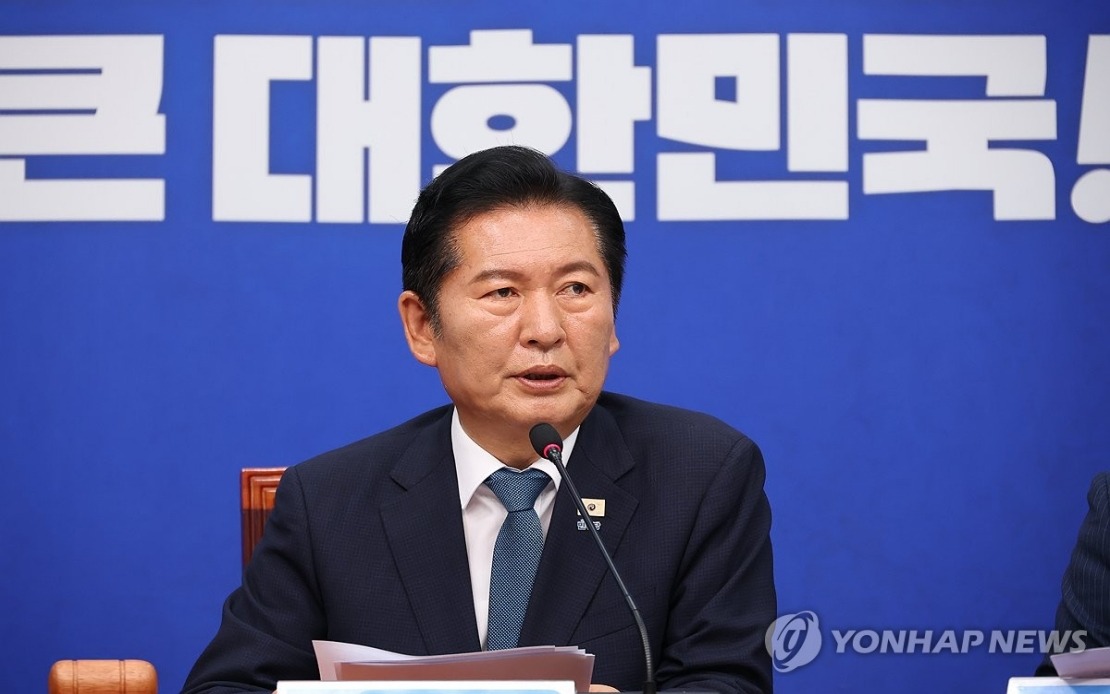
Jung Chung-rae stepped down as chairman of South Korea's ruling Democratic Party on Wednesday, a strategic move that opens the door for him to campaign for re-election when the party holds its national convention on August 17. The veteran lawmaker's resignation, announced during a meeting of the party's supreme council at the National Assembly, signals the beginning of an internal power struggle that will reshape the party's direction and influence over President Lee Jae Myung's administration.
In his resignation statement, Jung reflected on the personal toll of his leadership tenure, describing the constant pressures and conflicts that have defined his chairmanship. He emphasised his unwavering commitment to supporting the president's agenda and fostering cohesion between party structures and government institutions. Despite acknowledging the absence of peaceful days during his tenure—attributed to resistance from both within and outside the party—Jung stressed his willingness to perform his duties without complaint, framing his resignation as a conscientious decision rather than a retreat.
The resignation comes amid mounting tension within the Democratic Party between factions loyal to President Lee and those aligned with Jung's political vision. Critics from the president's camp have accused Jung of prioritising the interests of his own supporters and pursuing a leadership style disconnected from the administration's core objectives. These tensions highlight deeper divisions within South Korea's ruling coalition, where personal loyalties and political philosophies often compete for dominance.
The August convention is shaping up as a three-way battle for the party leadership. Beyond Jung, two formidable contenders are positioning themselves for the race. Prime Minister Kim Min-seok, regarded as one of President Lee's most trusted political allies, represents continuity with the current administration's agenda. Former Democratic Party leader Song Young-gil, a seasoned politician with significant party credentials, has signalled his intention to enter the contest. According to Democratic Party lawmaker Park Jie-won, Song has informed the president of his candidacy plans and has floated the possibility of consolidating his campaign with Kim's, potentially to present a unified challenge to Jung.
The strategic manoeuvring among these three candidates reveals the complex calculations inherent in South Korean party politics. Song's willingness to discuss unifying with Kim suggests that both may view Jung as the primary obstacle to their preferred vision for the party's future direction. Such coalition-building before the formal campaign phase underscores how internal party conventions operate as genuine competitions for power, with significant implications for government policy.
Until the August 17 convention, Democratic Party floor leader Han Byung-do will assume the role of acting party chairman. This interim leadership arrangement ensures continuity of party operations while avoiding the appearance of favouring any particular candidate. Han's position as acting leader places him in a delicate situation, requiring him to manage party affairs neutrally while three ambitious politicians campaign for the top job.
For Malaysian and Southeast Asian observers, this episode in South Korean politics demonstrates how even ruling parties in established democracies must navigate internal power competitions. The tension between supporting a sitting president and maintaining party independence reflects universal challenges of political organisation. In the South Korean context, the convention will likely determine not only who leads the Democratic Party but also how assertively the party challenges or supports presidential initiatives in the coming months.
The outcome of August's convention carries broader implications for South Korea's political trajectory. A Jung victory would suggest that the party's base remains committed to a more independent political posture. A Kim victory would reinforce alignment with Lee's administration, while a Song triumph could represent a middle path. Regardless of the outcome, the succession process will reshape the balance between presidential and party institutional power at a critical juncture in South Korean governance.
The Democratic Party's internal competition also reflects generational and ideological shifts within South Korea's conservative political establishment. Jung, Kim, and Song each represent different approaches to governing and different constituencies within the party ecosystem. Their contest during August's convention will provide valuable insight into where South Korea's largest ruling party intends to position itself as Lee Jae Myung's presidency progresses toward its final years.