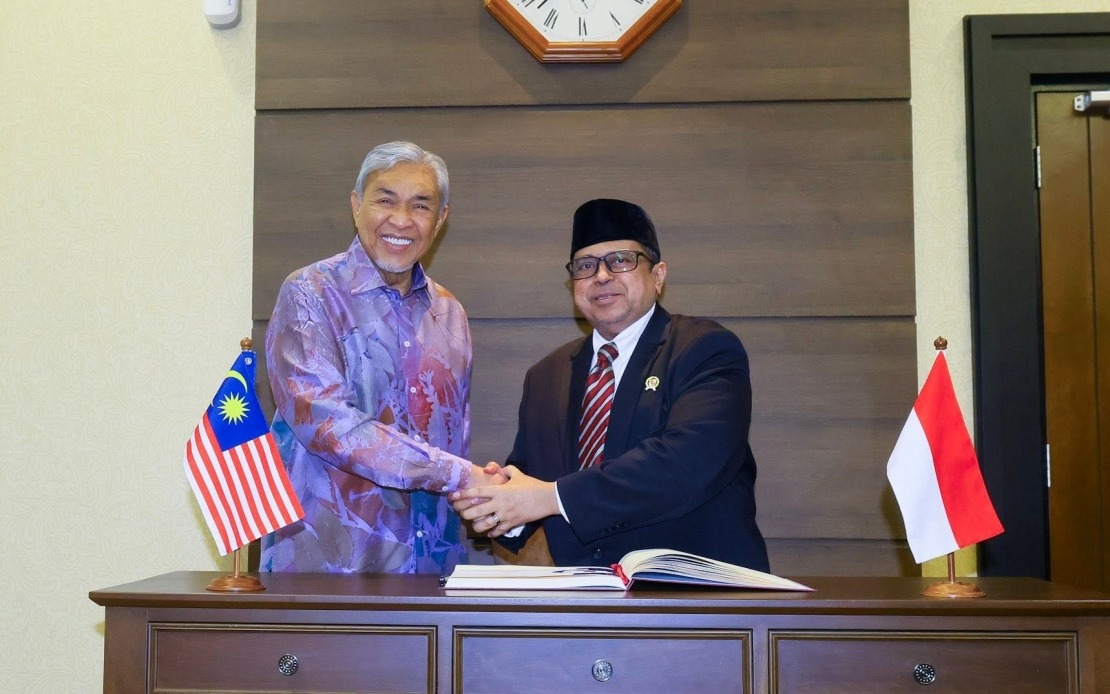
Malaysia and Indonesia are moving to intensify their partnership in the burgeoning halal industry, with both nations positioning themselves to lead standards-setting and market development across the Muslim world. The commitment emerged during discussions between Deputy Prime Minister Datuk Seri Dr Ahmad Zahid Hamidi and senior Indonesian officials visiting Parliament, signalling renewed momentum in bilateral relations that extend well beyond the halal sphere into trade, rural development and workforce capacity building.
The conversation between Ahmad Zahid and Indonesia's Ambassador to Malaysia Raden Datuk Mohammad Iman Hascarya Kusumo, alongside Dr Ahmad Haikal Hassan, who heads Indonesia's Halal Product Assurance Organising Body (BPJPH), underscores the strategic importance both governments attach to coordinating their halal ecosystems. These discussions reflect a broader recognition that the halal market represents one of the most dynamic growth sectors in Southeast Asia, with consumer demand expanding rapidly across Muslim-majority nations and increasingly among non-Muslim consumers in developed economies seeking certified ethical products.
Central to the deepening cooperation is a proposed Malaysia-Indonesia Halal Council (MIHC), which would serve as a bilateral platform for coordinating policy, standards and investment strategies in the sector. This builds upon existing frameworks but creates dedicated institutional machinery specifically designed to tackle the complexities of maintaining aligned regulatory approaches whilst allowing each nation to pursue its competitive advantages. Malaysia has long positioned itself as a global halal hub through its certification infrastructure and established brand reputation, whilst Indonesia commands the world's largest Muslim population and substantial manufacturing capacity, making collaboration mutually beneficial.
Beyond bilateral arrangements, both nations are envisioning broader regional and global institutional frameworks. The proposed ASEAN Halal Council would extend coordination across the entire Southeast Asian bloc, addressing fragmentation that currently complicates cross-border trade in certified products. Such a body could harmonise baseline standards across member states, reducing compliance costs for manufacturers operating in multiple markets and streamlining certification processes that often require navigating disparate national requirements. This regional approach positions ASEAN to exercise greater influence over international halal standards development.
Acknowledging the need for global frameworks, the officials discussed establishing a World Halal Development Council, signalling ambition to shape international norms rather than simply adapting to standards set elsewhere. Malaysia and Indonesia together represent enormous economic and demographic weight in global halal markets—combined they account for substantial portions of the world's Muslim population and significant manufacturing and trade volumes. A council anchored by these two nations could legitimately claim to represent broader global Muslim interests in halal certification and development.
The institutional architecture being discussed addresses a fundamental challenge facing the halal industry: the absence of truly unified international standards despite decades of discussion. Currently, different nations operate their own certification systems, creating barriers for manufacturers seeking to serve multiple markets. A Moroccan halal-certified product may not be automatically recognised in Malaysia or Indonesia, fragmenting supply chains and limiting market access. These proposed councils would work systematically to harmonise such standards, making halal certification genuinely portable across borders and substantially reducing friction in global halal trade.
Ahmad Zahid, in his capacity as chairman of the Malaysia Halal Industry Development Council, emphasised that these institutional initiatives aim to expand investment and business opportunities for both nations. The halal industry encompasses food and beverages, cosmetics, pharmaceuticals, tourism, logistics and financial services—a broad ecosystem generating tens of billions of dollars annually. By aligning regulatory frameworks and creating predictable investment conditions, Malaysia and Indonesia could attract significantly greater foreign direct investment from global halal-focused firms seeking to establish regional production and distribution hubs.
The historical relationship between Malaysia and Indonesia provides substantial foundation for these ambitions. The two nations share cultural ties, religious commonality, and integrated supply chains across numerous sectors. However, they also compete actively in halal certification and trade, particularly in exporting to third countries. The collaborative approach being adopted suggests both governments have concluded that the market is large enough to accommodate competition within a framework of mutual standard-setting, rather than viewing coordination as threatening to national competitive positions.
For Malaysia specifically, deepening halal cooperation with Indonesia represents both opportunity and strategic necessity. Indonesia's massive population and manufacturing base mean that the nation increasingly captures market share in halal products traditionally dominated by Malaysian exporters. By establishing formal coordination mechanisms, Malaysia preserves influence over standards development and can ensure its certification infrastructure remains the gold standard, protecting premium positioning in global markets. Meanwhile, cooperation opens opportunities for Malaysian service providers, consultants and technology companies to support Indonesia's halal sector development.
The timing of these discussions reflects accelerating global demand for halal-certified products. Beyond Muslim-majority nations, developed markets including Europe, Australia and North America are witnessing growing halal consumption driven by immigrant communities and consumer preferences for transparent, ethical sourcing. A unified ASEAN approach to halal standards and certification would enhance the region's ability to capture shares of these lucrative markets by offering streamlined access to certified products meeting transparent international benchmarks.
Indonesia's recent establishment of the BPJPH represents significant institutional investment in halal sector governance, suggesting sustained political commitment to the industry's development. Dr Ahmad Haikal Hassan's participation in discussions with Malaysian counterparts indicates Indonesia is actively seeking bilateral partnerships to strengthen its halal architecture. This creates momentum for Malaysia to reciprocate through formal coordination arrangements, avoiding a scenario where the two nations develop incompatible systems that fragment the regional market they both serve.
These initiatives will require substantial follow-up work on technical standards, recognition frameworks and dispute resolution mechanisms. But the political commitment expressed at this level suggests both governments view halal cooperation as strategically important, likely to receive sustained bureaucratic attention and resource allocation. For investors and businesses operating in the halal sector across Southeast Asia, clearer regional standards and coordinated certification pathways could materially reduce operating costs and expand addressable markets, potentially accelerating industry growth trajectories.