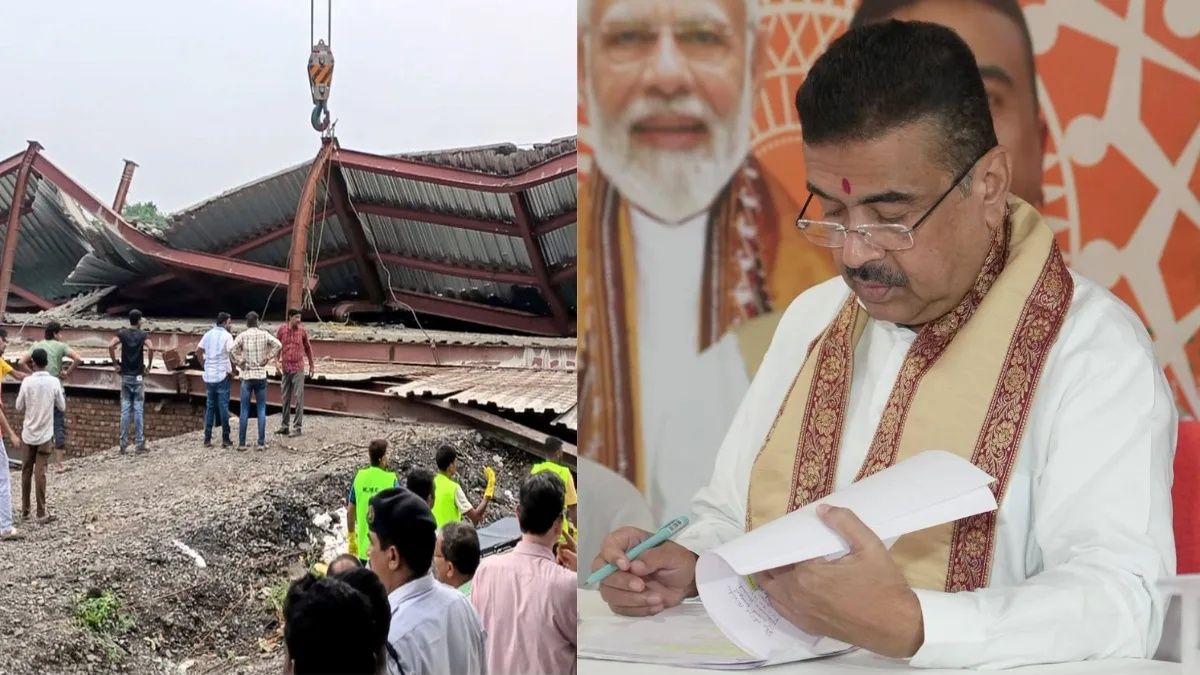
The catastrophic collapse of a warehouse in Kolkata's Taratala district has claimed 11 lives as rescue teams pressed on with operations into their second day, raising the grim toll another body at a time. Personnel from the Indian Army, the National Disaster Response Force, and allied agencies maintained their intensive search through the rubble on Thursday afternoon, with serious concerns that additional workers remain trapped beneath the debris and may yet be recovered in the coming hours.
The structural failure has become a flashpoint for political recrimination in West Bengal, with newly installed Chief Minister Suvendu Adhikari using his address to the state assembly to launch a forceful critique of the Kolkata Municipal Corporation under the previous Trinamool Congress administration. Adhikari presented documentary evidence suggesting the warehouse structure received municipal approval despite containing what he characterised as fundamental design defects that should have triggered rejection or mandatory redesign.
At the centre of the Chief Minister's allegations are former Mayor Firhad Hakim and the officials operating under his watch. Adhikari waved documents bearing Hakim's signature before the assembly, asserting that bureaucratic negligence and potentially corrupt decision-making allowed a structurally unsound building to proceed to construction. The government's internal fact-finding investigation, he indicated, had already substantiated these irregularities through official channels.
The political dimension of the crisis reflects broader concerns about building safety and regulatory oversight across India's metropolitan centres. Adhikari's accusations of "cut money"—colloquial reference to bribes extracted during the approval process—and his portrayal of Kolkata as having become a "city of death" under the previous regime represent not merely partisan point-scoring but underscore systemic governance failures that endanger public safety. The engineer signatures and officials involved in sanctioning defective plans are themselves now subjects of investigation.
Law enforcement has already moved swiftly to make arrests. Five individuals have been taken into custody: the construction supervisor, the iron structure fabricator, the site lessee, the labour contractor associated with Trimex, and a broker who facilitated the municipal approval process. The primary accused, identified as Azgar, remains at large, with authorities conducting an active manhunt. These arrests represent an initial accountability mechanism, though questions about higher-level complicity and decision-making remain under examination.
Crucially, the Chief Minister announced a blanket suspension of all non-essential construction activity across a wide geographical footprint that extends well beyond Kolkata proper. The four-week moratorium encompasses the Kolkata Municipal area, the satellite cities of Rajarhat-New Town, Maheshtala, Budge Budge, and Pujali, along with Bishnupur, Sonarpur, and Baruipur. This sweeping measure underscores the severity with which the administration views the safety crisis and represents a dramatic acknowledgement that systematic problems likely pervade the regulatory landscape across multiple jurisdictions.
Paralleling the construction freeze, the government has initiated what amounts to a comprehensive re-examination of previously approved building plans within the affected zones. A specially constituted high-level committee chaired by Additional Chief Secretary Rajesh Pandey will oversee this massive audit exercise. The committee's composition itself signals an effort to break insularity and introduce external expertise: membership includes senior government officials alongside representatives from prestigious technical institutions including IIT Kharagpur, the Rail India Technical and Economic Service, and Indian Railway Construction Limited. The Fire Services Department and Public Works Department also have seats, bringing multiple perspectives on structural safety, fire codes, and construction standards.
The Taratala collapse occurred at a moment when structural safety failures have increasingly drawn scrutiny across India's construction sector. Southeast Asian readers will recognise parallels with building failures in their own regions, where rapid urbanisation, labour market pressures, and sometimes inadequate regulatory capacity create conditions for disaster. The involvement of the Indian Railways' technical and engineering arms in the audit process signals unusual seriousness—these organisations maintain rigorous safety standards for critical infrastructure and their participation suggests the state intends to apply railway-grade scrutiny to municipal building approvals going forward.
Adhikari's stern statements regarding consequences offer a preview of the government's intended response framework. Beyond imprisonment for those convicted, he indicated that property confiscation may be pursued to generate compensation funds for victims and their families. This approach, while potentially contentious from civil liberties perspectives, reflects determination to impose meaningful financial consequences on those culpable for the catastrophe. The message appears calculated both to reassure a shaken public that accountability will be thorough and to signal to construction industry actors that cutting corners carries real costs.
For Malaysia and other Southeast Asian economies, the Kolkata incident offers cautionary lessons about the preconditions that enable structural failures. Urban construction booms, while economically necessary, require robust permitting processes, regular third-party inspections, and enforcement mechanisms with genuine teeth. The rush to approve projects during periods of rapid development—whether driven by political pressure to deliver visible growth, inadequate inspector training, or outright corruption—creates disaster waiting to happen. The fact that multiple institutional layers (municipal corporation, police, construction companies, individual brokers) apparently contributed to the failure suggests that no single regulatory fix will suffice without broader governance reform.
The rescue operation's successful coordination between central armed forces and state agencies, which Adhikari publicly praised, demonstrates that when institutions function properly, lives can be saved. Yet the upstream approval failures that enabled the building to exist at all represent a more fundamental challenge to governance. The coming weeks will prove whether the mega-audit announced by West Bengal's government yields meaningful changes to how construction permits are evaluated and enforced, or whether the audit becomes another administrative exercise that lapses once political attention shifts. The 11 individuals who perished, and those still potentially trapped in the wreckage, represent the human cost of allowing such laxity to persist.